01Most games and apps don't fail at build: they fail at launch
Storefronts bury unknown titles within days. The App Store, Google Play, and Steam each have their own discovery mechanics, asset requirements, and review timelines, and a launch that treats them as an afterthought hands the build to an algorithm that has no reason to care. Launch is a discipline: positioning, storefront assets, wishlist capture, demo strategy, and a per-platform calendar: planned before the build finishes, not after.
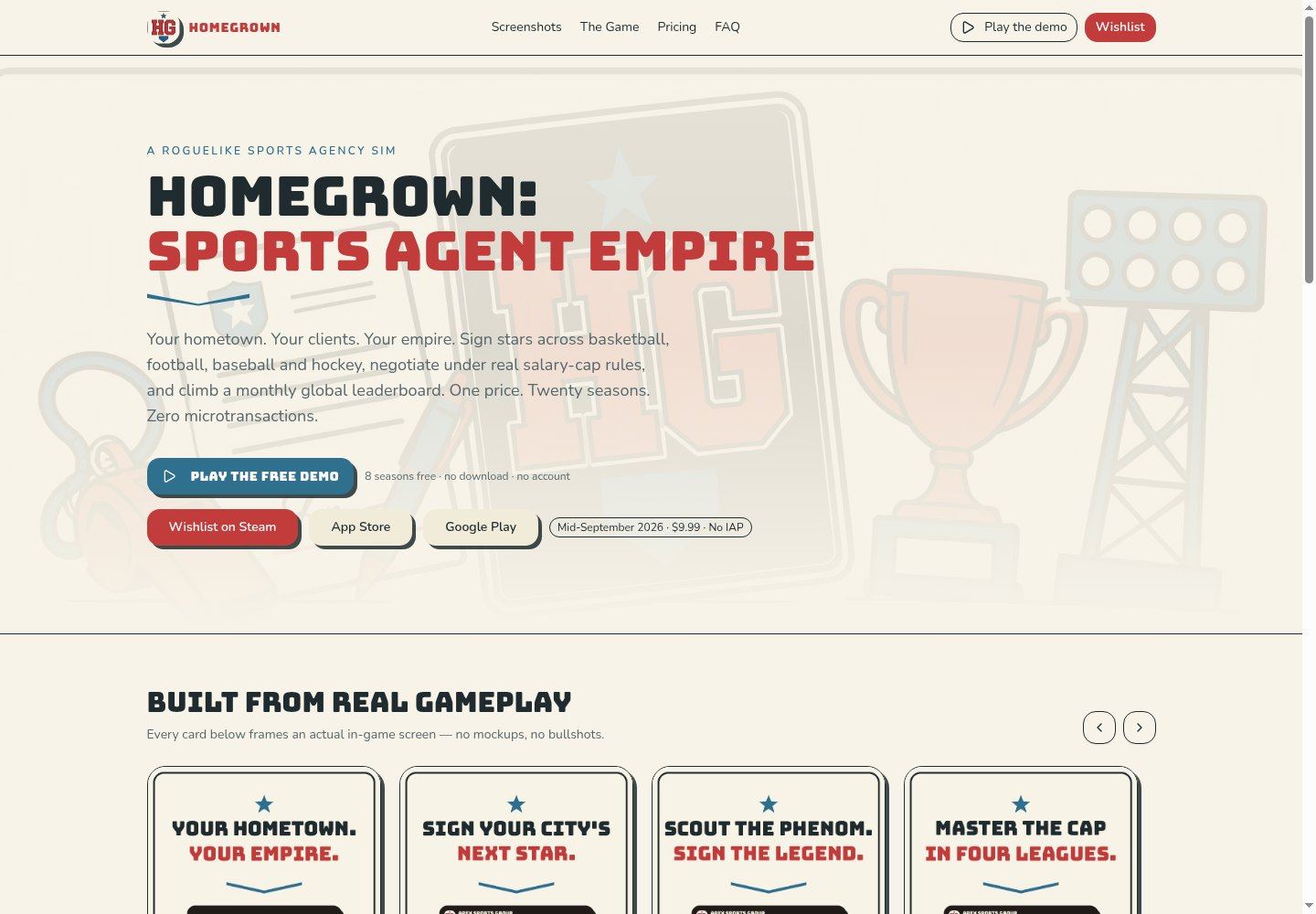
We know because we ship our own. Homegrown: Sports Agent Empire (a roguelike sports agency sim built and marketed by Tan Alto) launches September 11, 2026 on the App Store and Google Play, with Steam the week of September 21 and a free browser demo live today at sl-rs.games.
02Proof: Homegrown, our own title
Homegrown's launch runs the playbook end to end. The positioning is a policy (one $9.99 price, zero microtransactions, zero ads) because in a market trained to distrust free-to-play, fairness is the headline. The demo is the funnel: the first eight seasons of a career, playable in the browser with no download and no account, carrying its own all-time cross-platform leaderboard so the demo is a competition, not a trailer.
The calendar is engineered around platform reality. Valve requires a thirty-day waiting period for new Steam developers, so instead of tripping over it, the launch sequences around it: mobile first, Steam the following week, two news beats instead of one compromised date. One monthly global leaderboard spans every storefront, so the community never fragments across platforms.
03The marketing site is a launch asset
Every title needs a home that isn't a storefront listing: a place ads can land, press can link, and players can actually play. Our launch sites lead with the two actions that matter (play the demo, wishlist the game) and show real gameplay instead of rendered promises. Homegrown's site frames actual in-game screens as feature cards, because screenshots with receipts convert better than key art with adjectives.
The site also carries the launch's long tail: FAQ content that answers the questions storefronts can't, language support signaling for global audiences, and the analytics that tell us which channels produce wishlists rather than clicks.
04What a launch engagement covers
Positioning and pricing strategy, demo and funnel design, storefront page builds for Steam, the App Store, and Google Play, the marketing site, launch creative and per-platform ad campaigns, and the measurement layer that ties wishlists and purchases back to spend. For titles already built, we take over at positioning; for concepts, we're in from the design doc.