
Game Development & Multi-Platform Launch: In-House Venture
Launching a sports agency sim across four storefronts at once
Led by AJ Rodriguez Sanchez, Founder and Lead Strategist
4
Storefronts live: web, iOS, Android, Steam
5
Languages supported at launch
$0
Spent on microtransactions: there are none
$0
Ad spend behind the Steam launch: organic only
The challenge
Indie games don't get second chances at launch. Homegrown: Sports Agent Empire, a roguelike sports agency sim where you sign athletes across four leagues, negotiate under real salary-cap rules, and build a twenty-season legacy: needed to arrive on mobile and Steam with an audience already waiting, against storefronts that bury unknown titles in days. Tan Alto built the game and the launch as one project.
The approach
- 01
Positioning as a design decision, one price ($9.99), zero microtransactions, zero ads, zero energy timers. In a market trained to distrust free-to-play, fairness itself became the headline.
- 02
A free browser demo as the top of the funnel, the first eight seasons of a career, playable on the marketing site with no download and no account, carrying its own all-time cross-platform leaderboard so the demo is a competition, not a trailer.
- 03
Storefront sequencing around platform rules: App Store and Google Play launched September 11, Steam followed on October 19, planned around Valve's 30-day waiting period for new developers rather than tripped by it.
- 04
One leaderboard across every platform, a monthly global bracket shared between Steam and mobile, so no matter where a player buys, they compete in the same race and the community never fragments.
- 05
Five languages at launch (English, Spanish, French, Chinese, and Korean) because sports fandom is global and a management sim travels well.
- 06
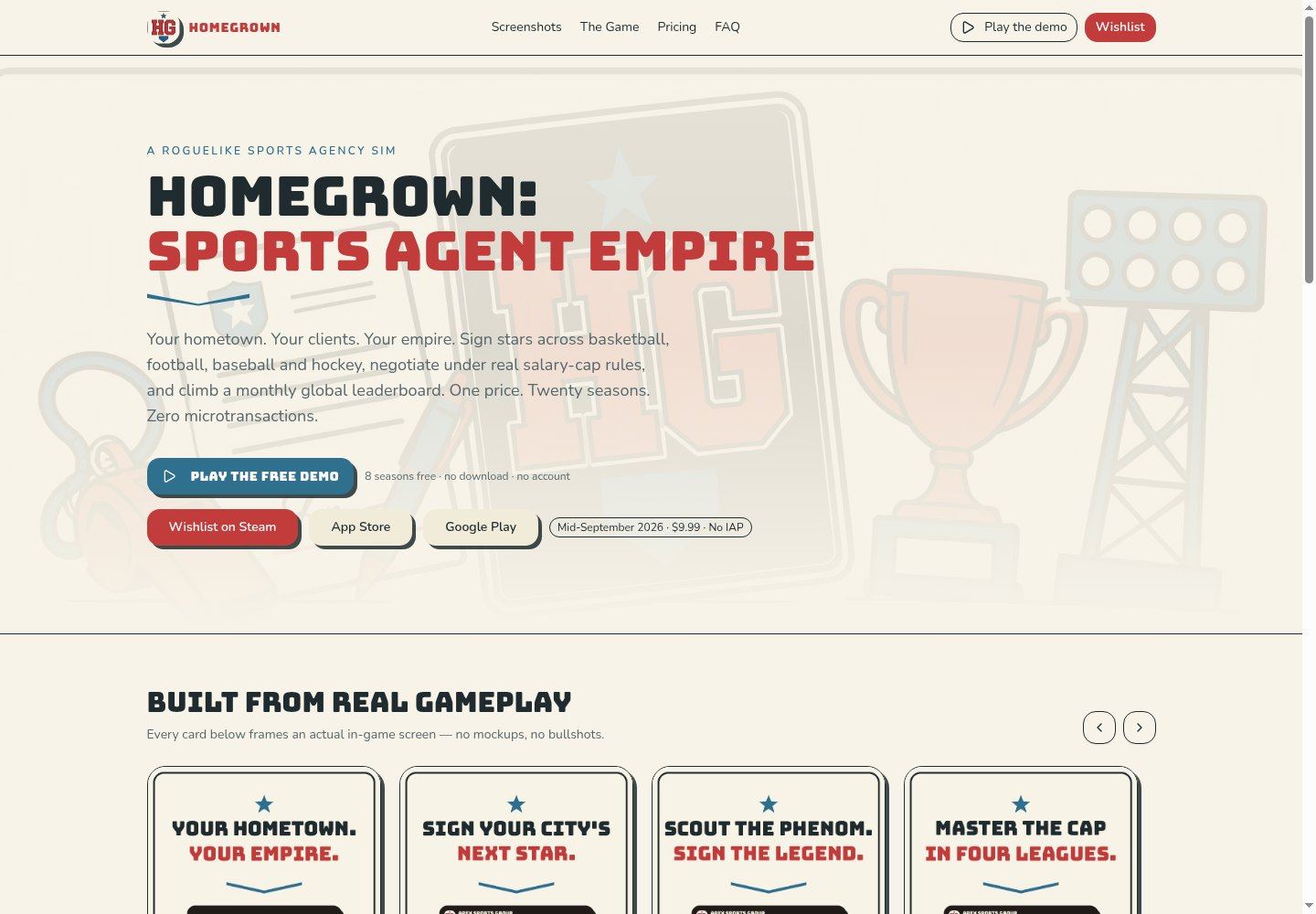
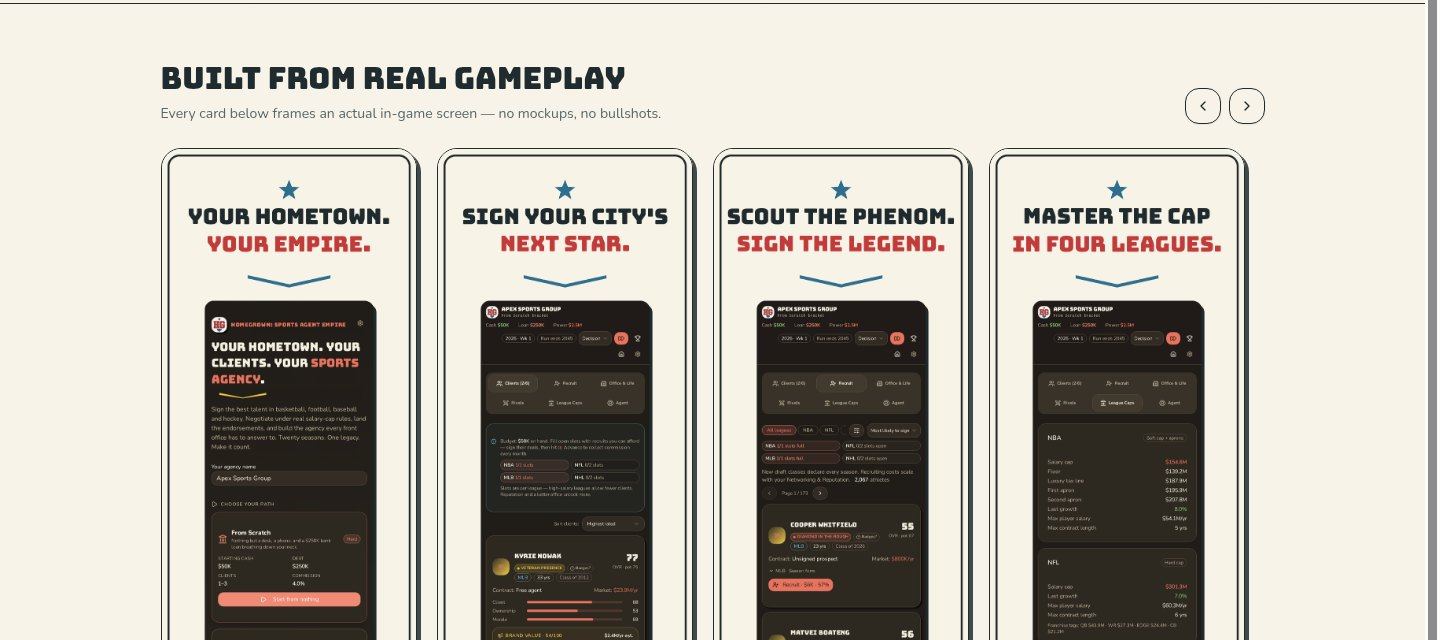
A marketing site that shows receipts, every screenshot on sl-rs.games is an actual in-game screen, with wishlist and demo calls to action above the fold.
Why it worked
The strongest marketing asset Homegrown has is a policy: no IAP. Mobile players have been burned for a decade by free games that monetize impatience, so the entire launch message inverts it, one price, everything included, wins come from decisions. That positioning costs nothing and differentiates against ninety percent of the storefront.
The browser demo does the work a trailer can't. Eight free seasons is enough of a career to produce attachment, and the all-time leaderboard gives demo players a reason to return before launch day. Every wishlist and pre-order the campaign earns starts as someone who already lost a negotiation to a fictional GM.
Sequencing turned a platform constraint into a cadence. Valve's 30-day new-developer rule forces most indies into a delay; the launch plan absorbs it (mobile first, Steam the following week) creating two news beats instead of one compromised date.
The first ten days on Steam told us the funnel worked, and told us why. About 7% of everyone who had wishlisted the game became an owner on day one, and that rate held through the launch window even though wishlisting opened only four days before release. Roughly one in three buyers came from wishlists; the other two thirds bought cold off the store page, which means the capsule art, tags, and description convert strangers with no prior touch. Raw unit counts stay internal, the ratios are what prove the pre-launch work.
Multilanguage and multiplatform stopped being positioning and became measured payoff. Nearly half of launch-window revenue came from outside the United States, across more than forty countries, with China alone taking about 7% of units. Mac players took roughly 7% of units and Linux about 1.5%, so the builds most studios skip were worth about one sale in twelve. All of it on zero ad spend: the wishlist balance grew about 39x across the window, and creators began arriving inbound asking for review codes, earned media validating the launch without a dollar behind it.
This is what we mean by full-scope: game design, storefront assets, the marketing site, the demo funnel, and the per-platform launch calendar, all owned by one team. The same discipline we bring to a DTC relaunch applies to a Steam page; the storefront and the case study you are reading were built by the same team.
See it live
“A management sim built around fairness falls apart the moment progression is for sale, your wins come from your decisions.”
Growth you can put a number on.
Book a free consultation. We'll review your funnel, show you where the revenue is hiding, and give you a plan: whether you hire us or not.
Prefer to write first? Send us a message · Email [email protected] · Call (727) 280-6953